news

In-depth Analysis of Micro LED CPO Technology

65 views admin 2026-04-08

  • With the rapid development of large AI models and computing power clusters, scenarios such as data centers and high-performance computing have an increasingly urgent demand for short-reach high-speed optical interconnects. Traditional copper cables and silicon photonics CPO solutions have struggled to break through bottlenecks in power consumption and bandwidth. As a new optical interconnect solution that deeply integrates Micro LED technology and the CPO architecture, Micro LED CPO has become a key technology addressing these pain points with its core advantages of low power consumption and high integration. A purely technical analysis is carried out below from core dimensions.
  • I. Core Definition
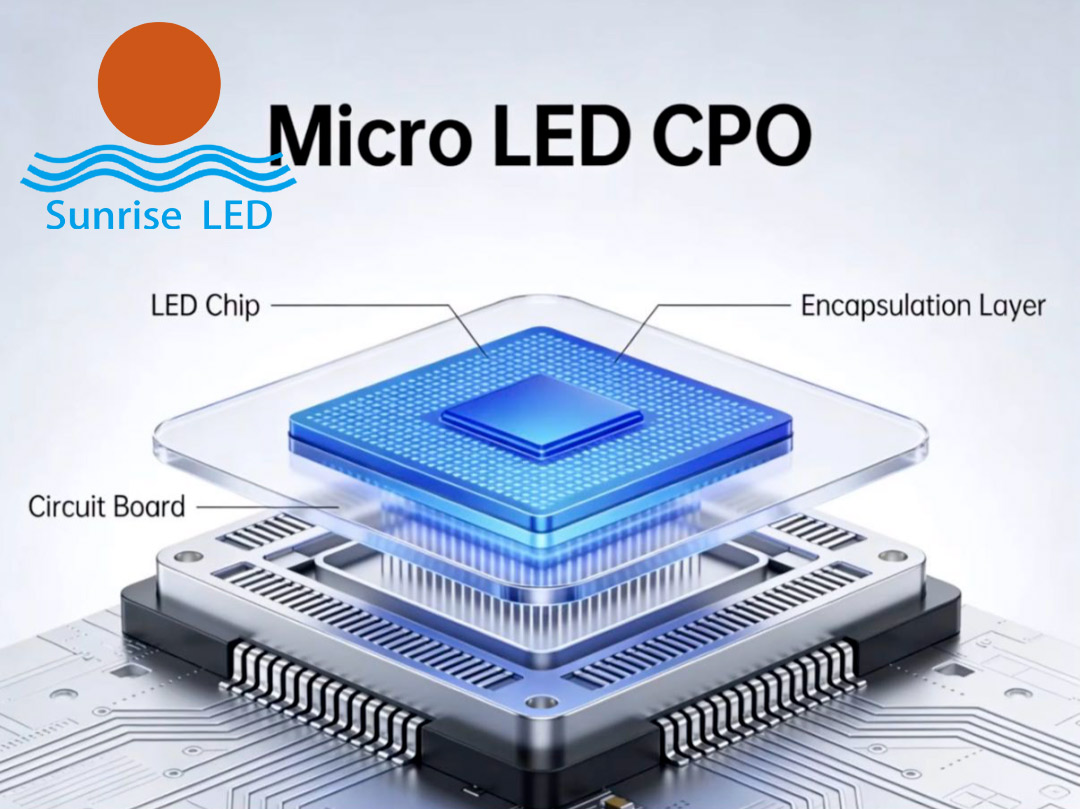
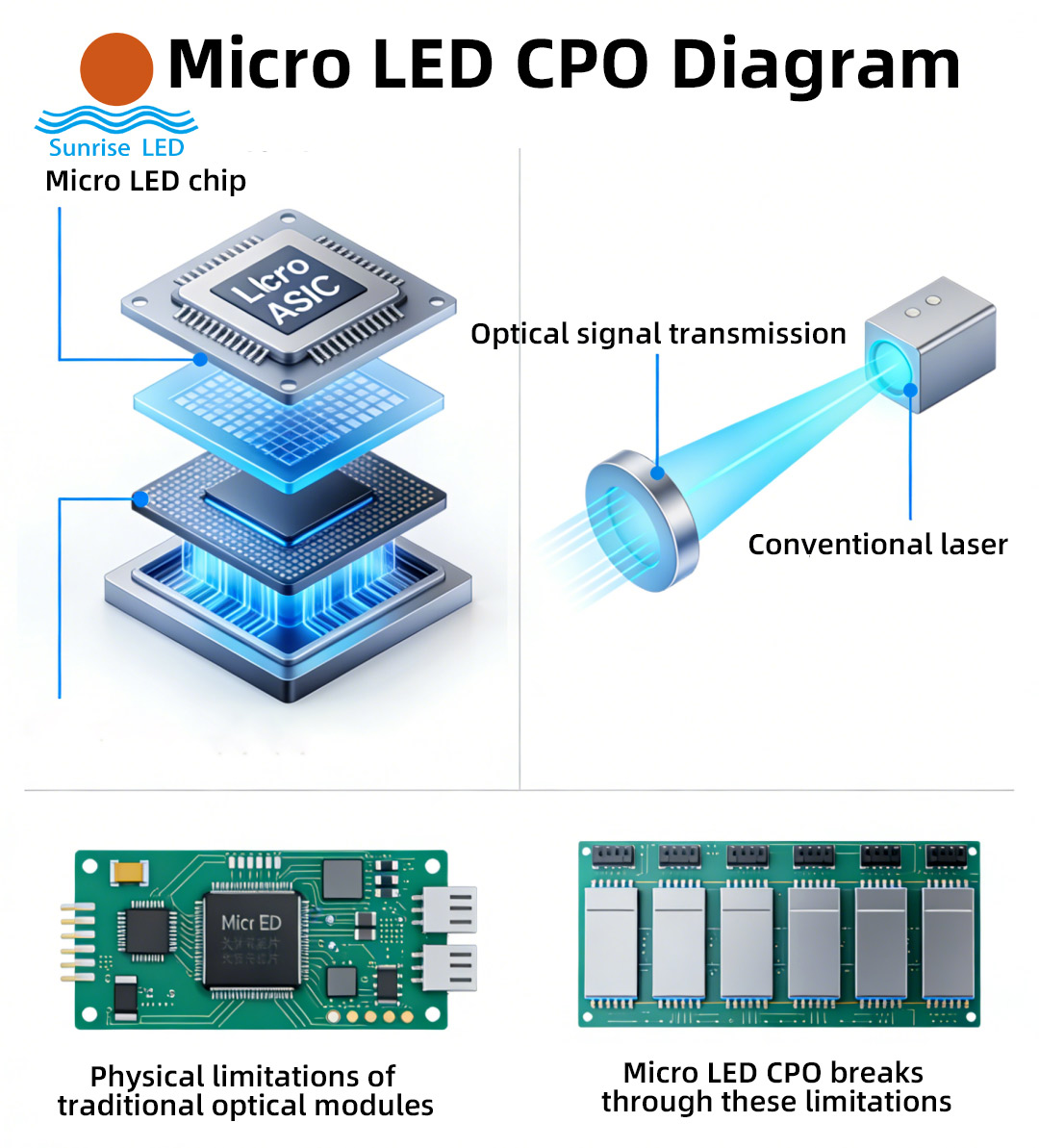
  • Micro LED CPO (Co-packaged Optics) is a technical solution for deep co-packaging of Micro LED chips with computing/switching chips. It uses micron-scale Micro LEDs to replace traditional lasers as optical interconnect light sources, enabling chip-level, board-level, and intra-cabinet short-reach high-speed optical transmission within ≤50 meters, solving the bottlenecks of traditional copper cables and silicon photonics CPO in the AI computing era.
  • II. Core Components
  • 1.Micro LED Chips: With a size of ≤50 μm, they feature nanosecond-level response and high luminous efficiency, and are naturally compatible with CMOS processes. Their core function is to replace lasers as signal light sources and directly achieve optical signal modulation through high-speed switching.
  • 2.CPO Architecture: Physically co-packages the optical engine with computing chips (GPU/ASIC), compressing the signal transmission distance from the traditional meter level to the millimeter level, greatly suppressing high-frequency attenuation and electromagnetic interference.
  • 3.Integration Solution: Micro LED arrays and CMOS drive circuits are integrated on the same substrate. Through packaging processes such as mass transfer and flip-chip bonding, they form a single package with computing chips, realizing parallel transmission of hundreds of channels.
  • III. Technical Principles
  • 1.Parallel Transmission Logic: Replaces a few traditional high-speed laser channels (single channel ≥25 Gbps) with hundreds of low-speed Micro LED channels (single channel 1–10 Gbps) for parallel transmission. High bandwidth of 1.6 Tbps/3.2 Tbps is achieved by stacking the number of channels, reducing the rate pressure and power consumption of a single channel.
  • 2.Chip-level Integration: After integrating Micro LEDs with drive circuits and co-packaging them with computing chips, the signal transmission path is greatly shortened, fundamentally reducing transmission loss and latency.
  • 3.Direct Optical Modulation: Utilizes the high-speed switching characteristics of Micro LED chips to complete signal modulation directly without additional modulators, simplifying the light source structure and lowering power consumption and process complexity.
  • IV. Core Technical Advantages
  • 1.Low Power Consumption: The power consumption of a 1.6 Tbps port is approximately 1.6 W, only 1/5 to 1/10 that of silicon photonics CPO and 5% that of copper cables, significantly reducing energy consumption and cooling costs in data centers.
  • 2.High Integration Density: Micro LED chips are much smaller than traditional lasers, enabling high-density packaging with a bandwidth density of 0.5 Tbps/mm², adapting to the compact deployment requirements at the chip level.
  • 3.Simplified Structure: The integration of light sources and drivers reduces components by more than 30%, and leverages mature LED production lines, lowering initial industrialization investment.
  • 4.High Compatibility: Nanosecond-level response matches high-frequency signals, with better signal integrity than traditional silicon photonics solutions, and is compatible with the renovation of existing data center architectures.
  • V. Key Technical Challenges
  • 1.Yield and Uniformity: The yield of mass transfer needs to be improved; the luminous efficiency and wavelength uniformity of Micro LEDs require optimization, and bottlenecks in epitaxy and transfer processes must be broken through.
  • 2.Wavelength and Bandwidth Adaptation: There is a discrepancy between the visible light band of display-grade Micro LEDs and the 850 nm/1310 nm bands for optical communication. The single-channel modulation bandwidth (≤10 GHz) is lower than the optical communication requirement (≥50 GHz), which needs to be enhanced by optimizing the epitaxial structure.
  • 3.Heat Dissipation Issues: High-density packaging leads to heat concentration. High thermal conductivity packaging materials and microchannel heat dissipation technologies need to be optimized to ensure long-term stable operation.
  • 4.Lack of Standards: There are no unified global testing and certification standards for Micro LED CPO, restricting large-scale industrialization.
  • VI. Industrial Landscape and Outlook
  • 1.Industrial Chain: The upstream includes Micro LED chips, CMOS drivers, and mass transfer equipment; the midstream covers packaging integration and optical engine design; the downstream focuses on scenarios such as AI data centers, high-performance computing, and edge computing.
  • 2.Technical Route: Competes with silicon photonics CPO as a dual-route solution. With its potential for low power consumption, high integration, and low cost, Micro LED CPO has become a core candidate for AI short-reach optical interconnects.
  • 3.Development Pace: Laboratory verification and small-batch trial production will be completed within 1 year; within 2–3 years, yield will rise to over 95% and costs will drop by 50%, achieving large-scale mass production; within 3–5 years, it will become the mainstream solution for short-reach interconnects in AI data centers.
   

Technology | analysis of naked eye 3D display technology

At present, the naked eye 3D large screen market is hot, and 3D technology is also known as 3D di...
Do you like ?2,788 views

Read more

Sunrise’s p2.604 curved LED display lights up under the Eiffel Tower

Sunrise’s p2.604 curved LED display lights up under the Eiffel Tower     Sunri...

Do you like ?1,779 views

Read more

Sunrise LED Rocky Rental Series led display for concert

Concert activities are popular in the United States, and sunrise’s products have been wide...

Do you like ?2,350 views

Read more

Sunrise 264 square meters Galaxy 3115 series mesh led facade in Armenia

  Sunrise 264 square meters Galaxy 3115 series mesh led facade in Armenia     Sun...
Do you like ?1,777 views

Read more

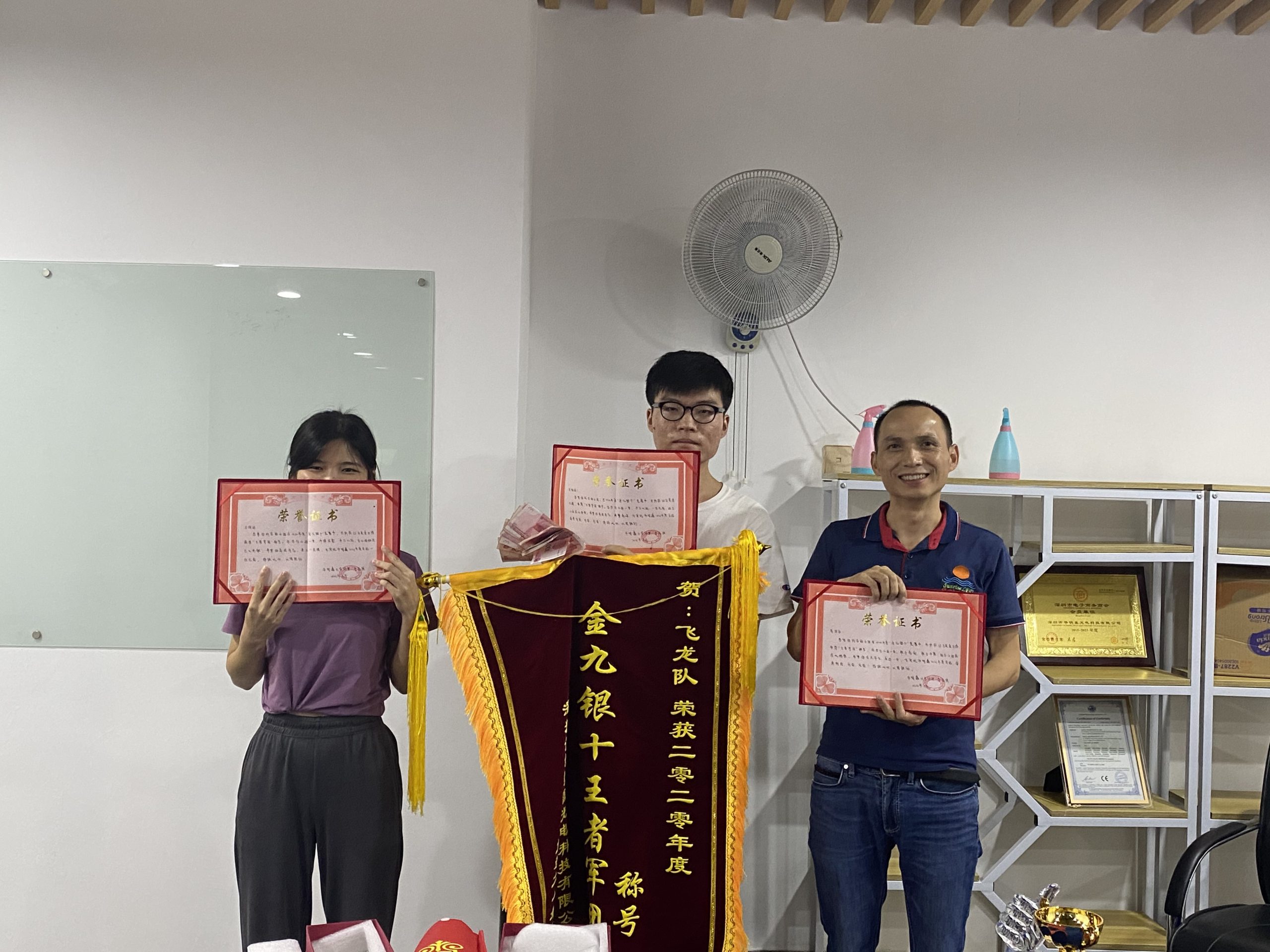
Sunrise led presents awards to excellent salesmen!

Doris, as a new salesman, won three orders in two months. It’s great.   Jack, the bu...
Do you like ?1,591 views

Read more

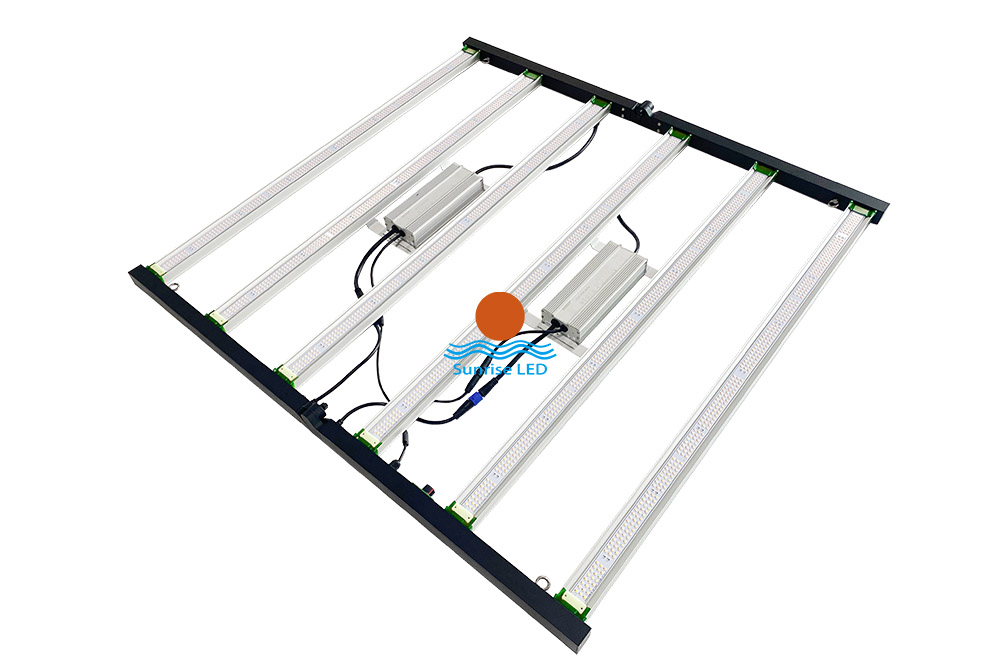
Our new product, led grow light, PPE reaches 2.6umol/j

640w and 800W full spectrum led grow light   It can be folded for convenient transportatio...
Do you like ?1,820 views

Read more

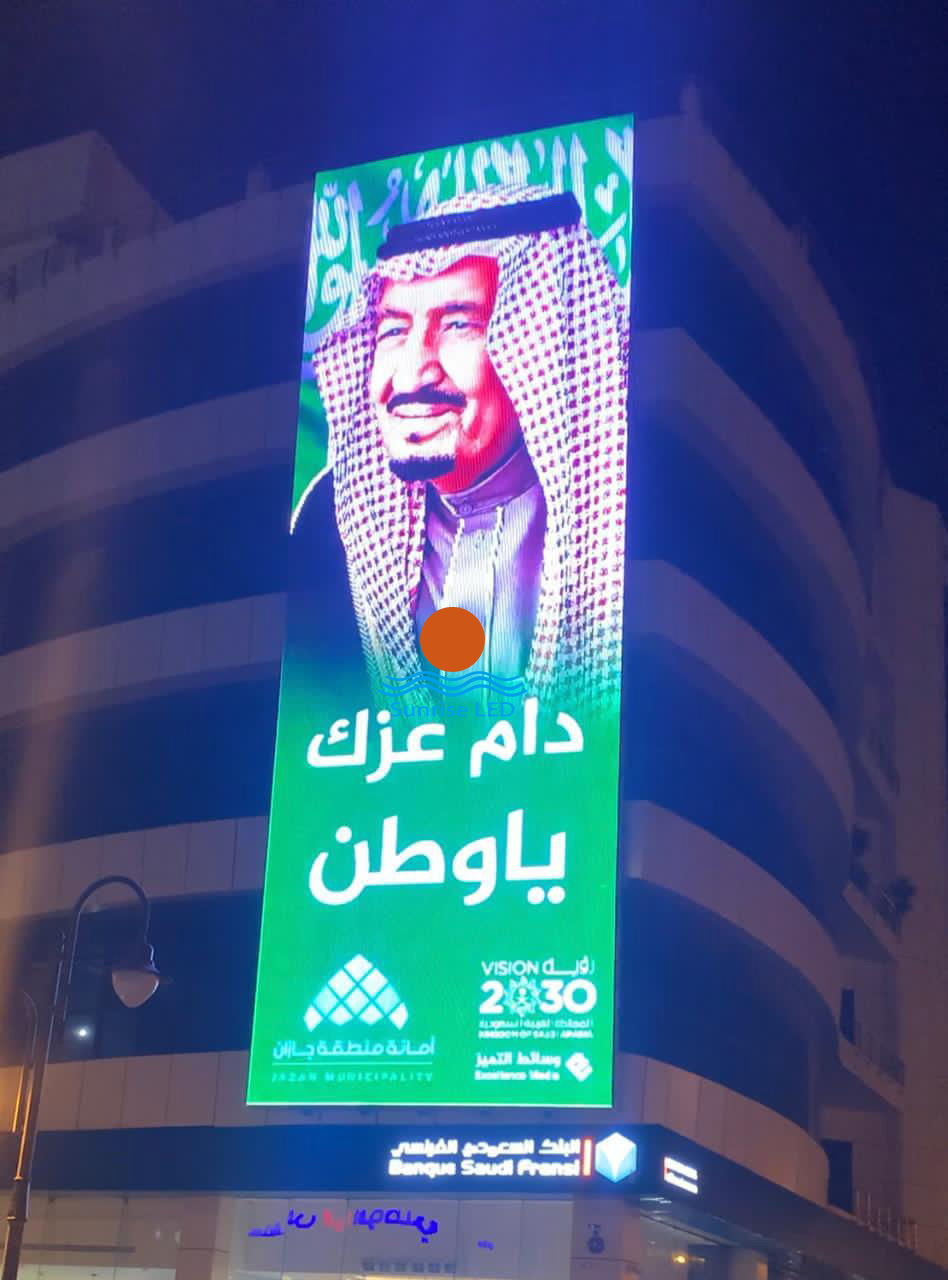
The latest project, Saudi Arabia LED MESH FACADE

The latest project, Saudi Arabia LED MESH FACADE. Ultra-high brightness, ultra-light LED display ...

Do you like ?2,347 views

Read more