news

What Are the Differences and Characteristics Between LCD, LED, OLED, and AMOLED?

6 views admin 2025-12-19

  • LCD, LED, OLED, and AMOLED—these are familiar display technologies, but what sets them apart in terms of working principles, advantages, disadvantages, and application scenarios? Let’s dive into a detailed exploration.
 
  • What’s the Difference Between LCD and LED Displays?
  • LCD (Liquid Crystal Display) and LED (Light-Emitting Diode) displays are two widely used technologies in TVs, computer monitors, mobile devices, and more. Simply put, they are distinct in their core composition: LCDs rely on liquid crystal layers, while LED displays are constructed from arrays of light-emitting diodes.
 
  • Working Principles LED Displays: Utilize light-emitting diodes as a backlight source. The LEDs emit light, which passes through a liquid crystal layer that regulates the level of light transmission.
 
  • LCD Displays: Depend on a liquid crystal layer to control light transmission. The liquid crystals are manipulated by an electric field—adjusting their molecular arrangement to either allow light to pass through or block it. Brightness and Contrast
 
  • LCD Displays: Typically offer lower brightness and contrast, with subpar visibility especially under direct sunlight. LED Displays: Boast higher brightness and contrast, delivering clearer, more vivid images even in bright environments.
  • Energy Efficiency and Color Performance
  • LCD Displays: Relatively power-consuming, particularly when the backlight is active. They provide decent color accuracy but struggle with deep blacks and limited contrast. LED Displays: More energy-efficient—independent control of LEDs enables dynamic backlight adjustment, reducing power consumption. They offer a wider color gamut and higher contrast, resulting in richer, more lifelike colors.
  • Cost and Size LCD Displays: More affordable, making them a cost-effective choice. Ideal for small-size devices such as mobile phones. LED Displays: Historically pricier, but costs have declined steadily with technological advancements and market competition. Suitable for all screen sizes, from large TVs to computer monitors. Common LCD Types
  • LCD displays mainly include TFT, UFB, TFD, and STN variants. TFT (Thin-Film Transistor) is the most prevalent type in laptop screens. Each liquid crystal pixel is driven by a thin-film transistor integrated behind it, enabling high-speed, high-brightness, and high-contrast display—ranking among the top LCD color display technologies and serving as the mainstream choice for laptops and desktops. Compared to STN, TFT offers superior color saturation, color reproduction accuracy, and contrast, remaining clearly visible even in sunlight. However, it is more power-hungry and costly. LED Applications LED applications fall into two primary categories:
  • LED displays; Single LED applications (e.g., backlight LEDs, infrared LEDs). Currently, China’s LED display design and manufacturing technology are largely on par with international standards. Composed of arranged light-emitting diodes, LED displays adopt low-voltage scanning drives and offer advantages such as low power consumption, long service life, low cost, high brightness, few malfunctions, wide viewing angles, and long viewing distances.
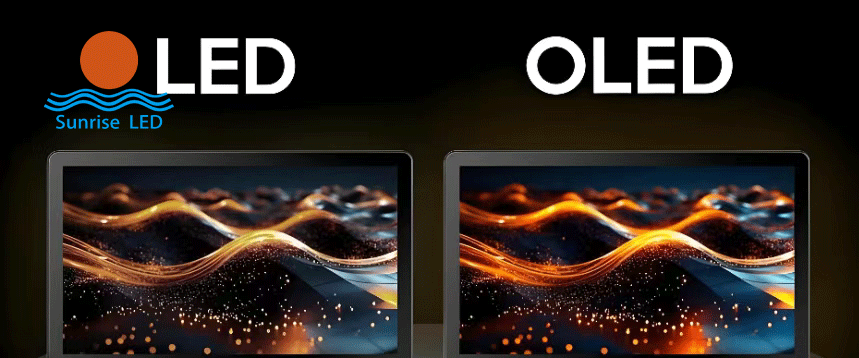
  • What’s the Difference Between OLED and LED Displays? OLED (Organic Light-Emitting Diode) and LED displays differ fundamentally in their light-emitting principles. Working Principles
  • OLED: Features an organic light-emitting layer sandwiched between two electrodes. Driven by an external voltage, electrons and holes injected by the electrodes recombine in the light-emitting layer to form excitons (bound electron-hole pairs). These excitons emit photons when radiatively excited, producing visible light. Unlike LEDs, OLEDs emit light directly without the need for a backlight. As a surface light source technology, OLEDs can generate monochromatic light (red, green, blue, white, etc.) to achieve full-color displays, representing an entirely new light-emitting mechanism. Technologies like plasma, OLED, and even early CRT are renowned for their image quality primarily due to their "self-illuminating" characteristic. LED: Emits light by controlling semiconductor light-emitting diodes. Typically composed of multiple red LEDs, displays rely on the on/off state of diodes to form images, leading to higher manufacturing costs. Additionally, LEDs can only be used as point light sources. Contrast and Color
  • LED Displays: Cannot control individual pixels independently. When displaying black, liquid crystals deflect to block the backlight, but some light leakage is inevitable—preventing true deep blacks. OLED Displays: Can turn off individual pixels completely, reducing brightness to zero. Theoretically, OLEDs offer infinite contrast, achieving true "pure black" and delivering more vivid, realistic images. While LEDs provide excellent color performance, OLEDs outperform them with a wider color gamut, more vibrant, rich, and accurate colors that faithfully reproduce image details. Screen Structure
  • OLED Displays: As thin as paper and flexible/bendable. Without the need for a backlight, OLEDs eliminate the liquid crystal and backlight modules, resulting in an extremely simple structure and ultra-thin design—roughly 1/3 the thickness of traditional LEDs. Future OLED TVs are expected to reach a thickness of less than 1mm, a feat unmatched by LEDs. LED Displays: Typically rigid panels composed of multiple diodes, lacking flexibility and making it challenging to produce curved or specialized shapes. OLEDs’ organic materials enable bending and folding, meeting the demands of applications like foldable phones and curved TVs. Energy Efficiency and Response Time
  • LED Displays: Require higher voltage and current to emit light, resulting in relatively high power consumption. While energy efficiency has improved with technological progress, LEDs still lag behind OLEDs. OLED Displays: Emit light at low voltage and current, eliminating the need for a backlight and significantly reducing energy consumption—offering a distinct advantage in energy efficiency. OLEDs also boast much faster response times, with no visible motion blur, making them superior for high-speed dynamic content. Additionally, OLEDs emit light with wavelengths closer to natural light, minimizing eye strain, whereas LED displays inevitably pose blue light hazards.
 

Technology | analysis of naked eye 3D display technology

At present, the naked eye 3D large screen market is hot, and 3D technology is also known as 3D di...
Do you like ?2,548 views

Read more

Sunrise’s p2.604 curved LED display lights up under the Eiffel Tower

Sunrise’s p2.604 curved LED display lights up under the Eiffel Tower     Sunri...

Do you like ?1,614 views

Read more

Sunrise LED Rocky Rental Series led display for concert

Concert activities are popular in the United States, and sunrise’s products have been wide...

Do you like ?2,168 views

Read more

Sunrise 264 square meters Galaxy 3115 series mesh led facade in Armenia

  Sunrise 264 square meters Galaxy 3115 series mesh led facade in Armenia     Sun...

Do you like ?1,630 views

Read more

Sunrise led presents awards to excellent salesmen!

Doris, as a new salesman, won three orders in two months. It’s great.   Jack, the bu...
Do you like ?1,443 views

Read more

Our new product, led grow light, PPE reaches 2.6umol/j

640w and 800W full spectrum led grow light   It can be folded for convenient transportatio...

Do you like ?1,654 views

Read more

The latest project, Saudi Arabia LED MESH FACADE

The latest project, Saudi Arabia LED MESH FACADE. Ultra-high brightness, ultra-light LED display ...

Do you like ?2,158 views

Read more
Technical Support: Magic Lamp